Landau 25 March 2026. Dr. Alejandro Simeone has presented new figures on the population of Humboldt penguins (1) and confirmed the sharp reduction in the population - by 63% compared to 2021/22 - also for Chile. The current surveys are part of a 6-year research project commissioned by Sphenisco and are funded by the Karlsruhe Zoo Species Conservation Foundation, the Friends of Hagenbeck Zoo and the Dresden Zoo. The following text presents the most important result and the discussion of the results. Summaries, introduction, material and methods, further results, full discussion, acknowledgements and literature can be found in the full report (1) (2) (to be submitted later).
Results
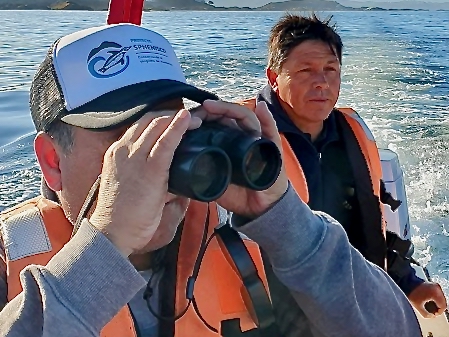
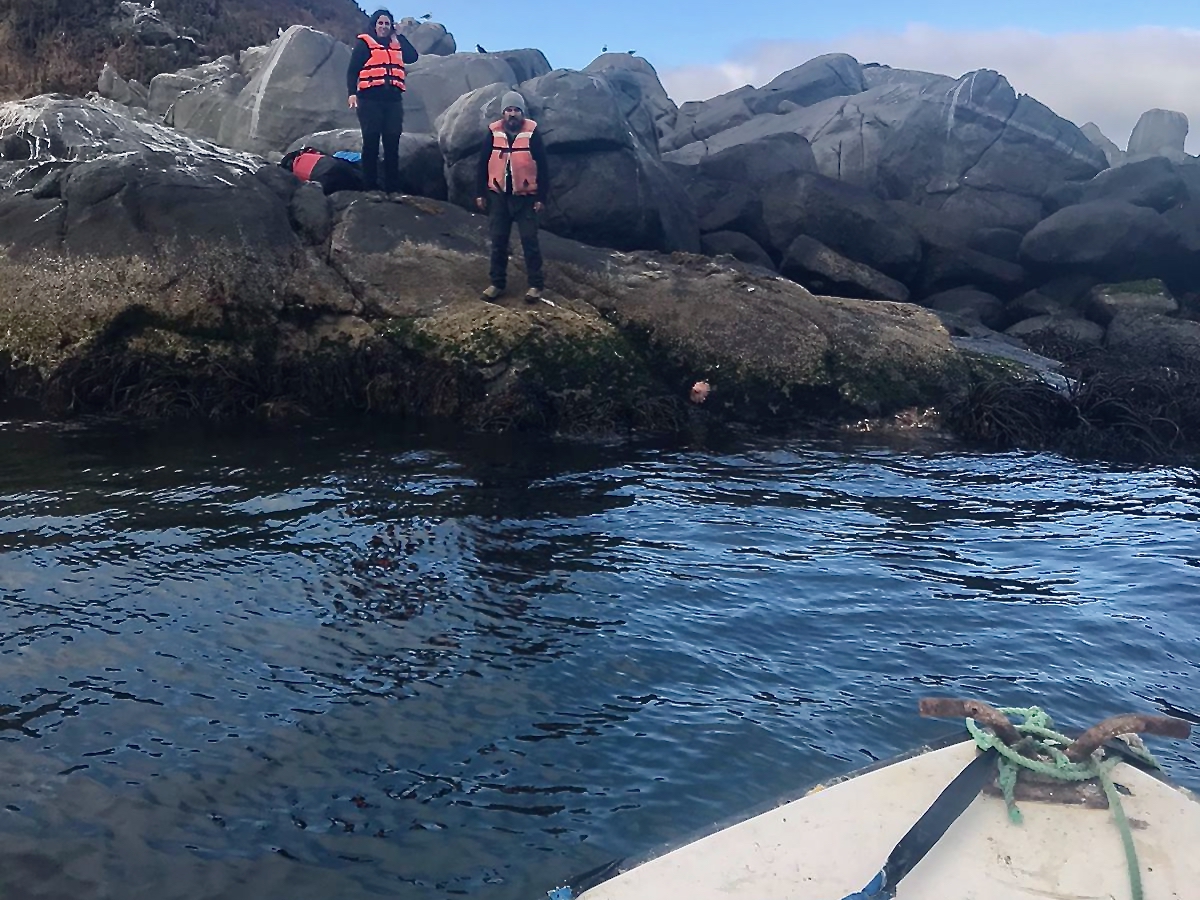
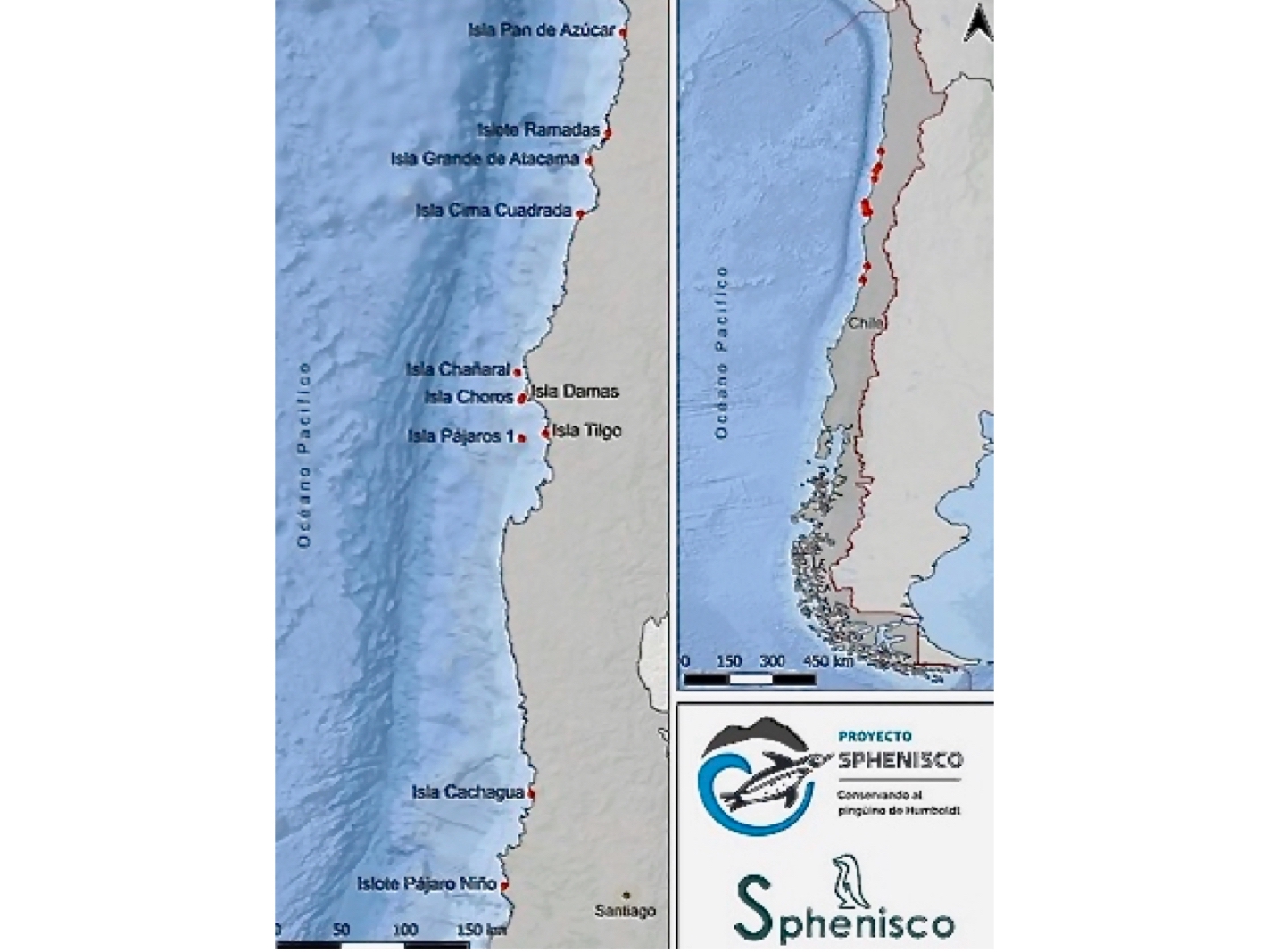
"In 2024 and 2025, we visited 11 islands with Humboldt penguin breeding colonies, from Pan de Azúcar Island to Pájaro Niño Island. The population sizes for each island are shown in Table 1. The counts took place mainly in the spring season (September-December), but some were also carried out in the autumn season (March-June) (see Table 1). To facilitate comparison with the previous study (Simeone et al. 2023), Table 1 also includes the counts carried out in 2021 and 2022.
Table 1 Size of the breeding population (number of active nests) of Humboldt penguins on islands in northern and central Chile, period 2021-2025. Values with (*) denote counts in the autumn season (March-June). If there are several measurements, the higher value will be taken into account.
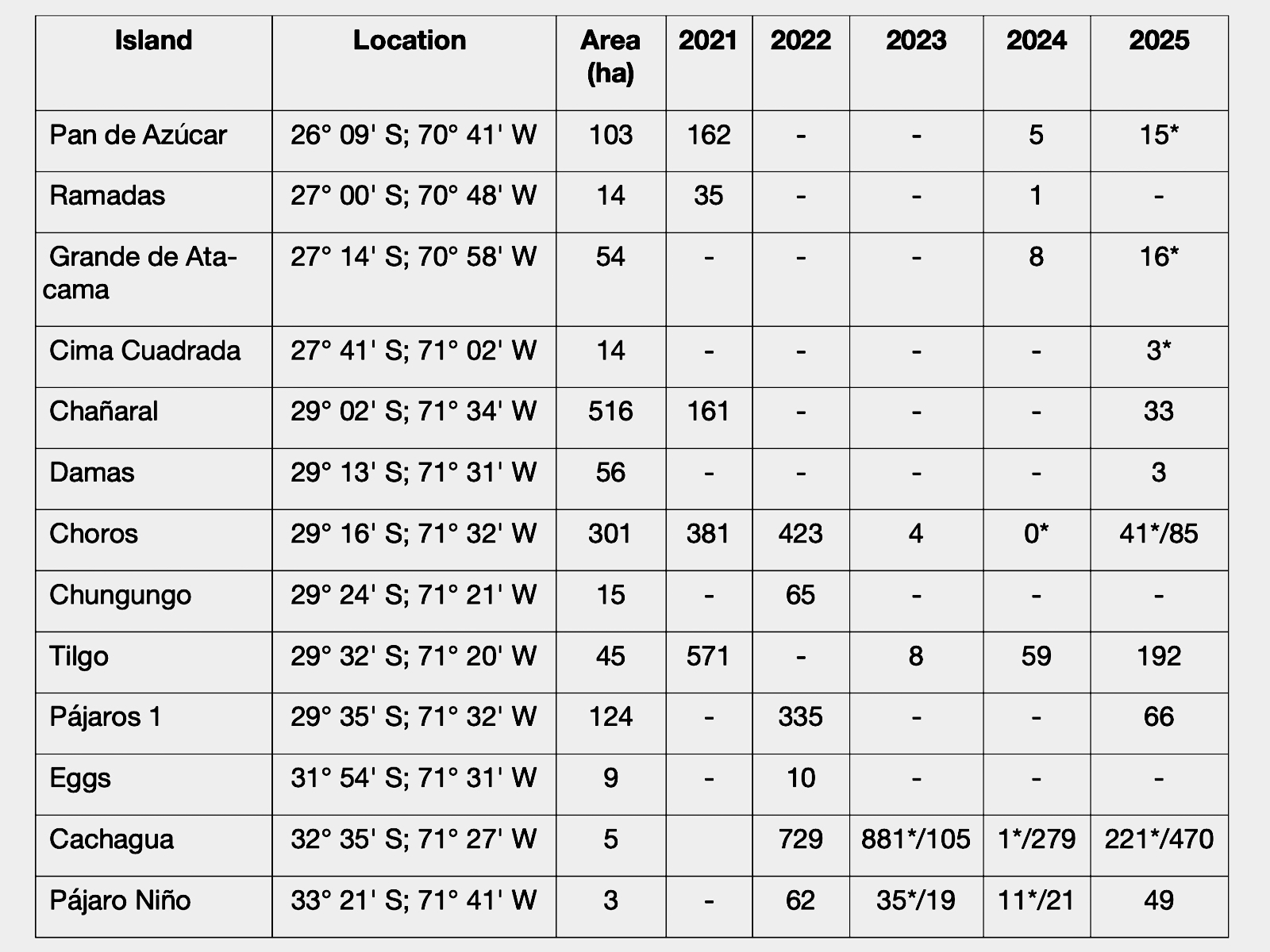
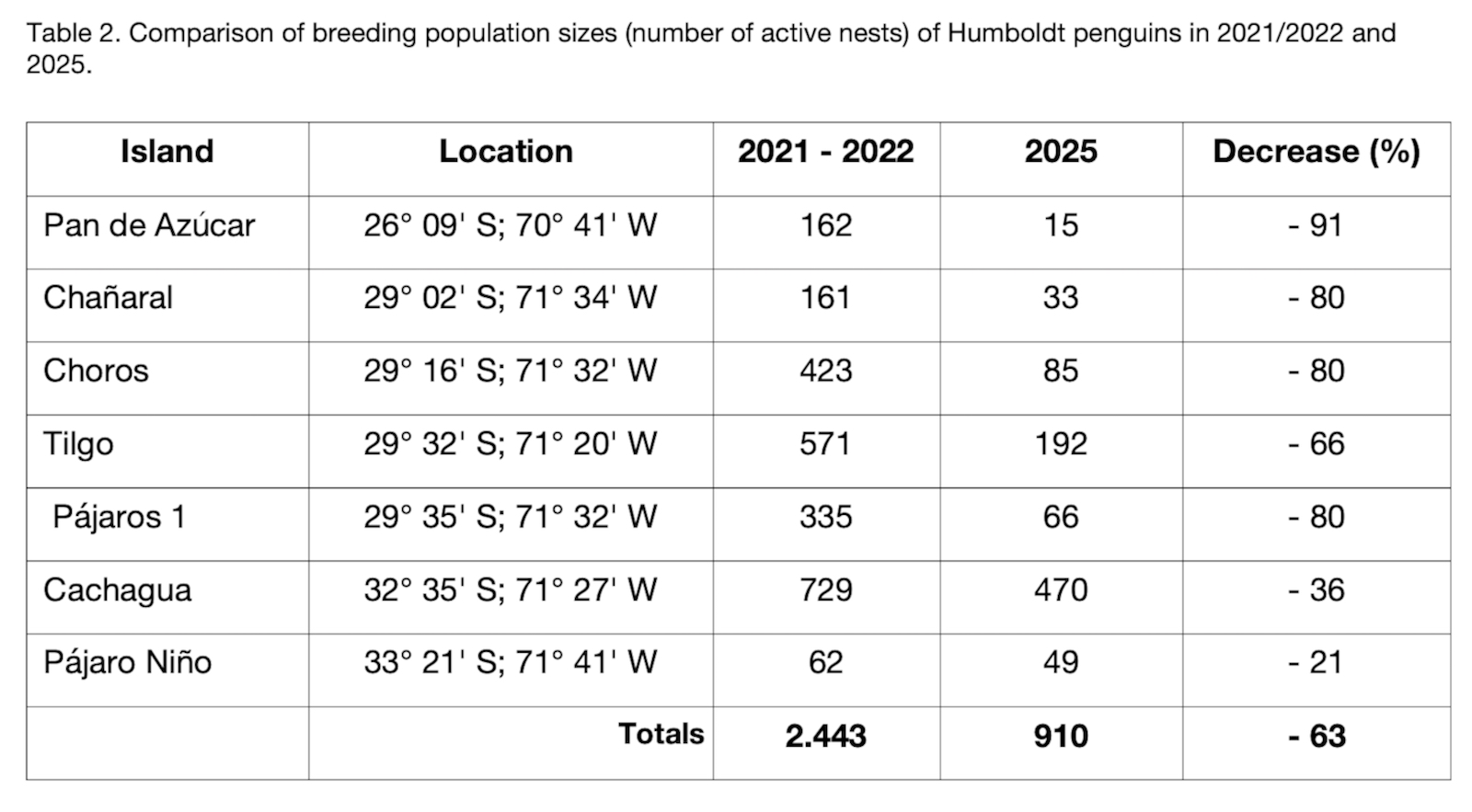
To assess the difference between the population sizes recorded in 2021/22 and 2025, we compared the data of those islands for which information was available in both periods. For islands with two population sizes in the same year (autumn and spring), the higher value was always used. This comparison (Table 2) shows that a decrease was recorded on all islands in the periods compared. The largest decreases were recorded in the islands of the northern zone (26-29°S), with decreases between 66% (Tilgo) and 91% (Pan de Azúcar). In the central zone (32-33°S), the decreases were smaller, between 21% (Pájaro Niño) and 36% (Cachagua Island).
(...)
Discussion
"The results of the present report show that the size of the breeding population of the Humboldt penguin on the islands in north-central Chile decreased by 63% in the period 2021/2022 and the year 2025. This decline was more pronounced in the northern zone (26-29°S), where colonies decreased between 66% and 91%, while populations in the central zone (32-33°S) decreased by 21% to 36%. The A/I index, which expresses the ratio between active and inactive nests, is consistent with this decline (...) This decline could have two explanations:
1. The high mortality rate of penguins registered in 2023 - attributed to the outbreak of bird flu and
2. the occurrence of a severe El Niño event in 2023/2024.
In December 2022, the first case of dead birds caused by the highly pathogenic
bird flu (H5N1) was registered. This disease killed about 100,000 wild birds (...) Muñoz et al. (2024) reported that between January and August 2023, more than 2,700 penguins (mostly Humboldt penguins) on the Chilean coast died – a number that rose to 3,500 by the end of December 2023, according to statistics from the Servicio Nacional de Pesca y Acuicultura (Sernapesca). Although this penguin mortality has been attributed to bird flu, there may be other causes involved. Segura-Cobeña et al. (2025) estimated, based on surveys of small-scale fishers, that more than 4,000 Humboldt penguins died in 2023 due to fisheries interactions in the area from northern Peru to central Chile, mainly drowning in gillnets. The high penguin mortality observed in 2023 probably had mixed causes; regardless, it is undeniable that these were unusually high mortality rates, compared to previous years (Simeone et al. 2021, Muñoz et al. 2024).
As of June 2023, in the middle of the avian flu outbreak, the onset of an El Niño event was declared, which lasted until April 2024 and significantly altered oceanographic conditions and marine productivity in the Pacific (Minobe et al. 2025; Peng et al. 2025). This explains the very low breeding activity of the Humboldt penguin observed on the visited islands that year - up to the complete absence of breeding efforts on the island of Choros in spring 2024 (see Table 1). During El Niño events, the breeding activity of Humboldt penguins decreases by 55% to 85%, and the few birds that do breed have low breeding success (Simeone et al. 2002).
The combination of these two factors, which acted synergistically and simultaneously in the second half of 2023, could largely explain the drastic decline in the breeding population size of the Humboldt penguin. Although the 2021-2022 level will not be reached, our data show that from 2025 onwards, a slight population recovery can be observed on all islands studied. This recovery could be due to the penguins returning to their colonies to breed after the end of El Niño, and after oceanographic conditions improved. Such a recovery was observed after the El Niño events of 1982/83 (Araya & Todd 1988) and 1997/98 (Simeone et al. 2002). Although this recovery is usually rapid - especially in La Niña conditions - in the present case it is very likely that it will be slow, as a significant part of the population died in 2023. It is difficult to predict how this high mortality will affect the population structure and dynamics of the Humboldt penguin – especially in a species with a low reproduction rate that is very sensitive to local oceanographic conditions (Simeone et al. 2002, Simeone & Wallace 2014).
Although the present study does not show all breeding colonies described on a national scale, the 11 islands assessed correspond to the historical breeding core of the Humboldt
Penguins in Chile. In the 2017 census, which included 45 colonies and recorded 5,067 breeding pairs at the national level, the colonies between 26°S and 33°S concentrated the largest proportion of the Chilean population (Simeone et al. 2018). Several of the islands included in this study (e.g. Choros, Chañaral, Tilgo, Pájaros 1 and Cachagua) were among the largest colonies in this census and are the ones identified by the RECOGE plan (a Chilean initiative led by the Ministry of the Environment to protect native flora and fauna) as the most important islands to be monitored. Together, these colonies represented about 90% of the total number of breeding pairs estimated in 2017, indicating that the monitoring conducted in 2024/2025 covered the most demographically relevant part of the Chilean Humboldt penguin population.
The Humboldt penguin is a species that has been subject to constant population decline in Chile over the past 40-50 years (Araya 1983, Simeone et al. 2018, Simeone et al. 2023). As a result, the species was classified in the category of "critically endangered" (EN) by the Chilean Ministry of the Environment in 2025. In 2026, it was declared a natural monument, which grants it protection throughout the national territory (whether it is a protected area or not) and prohibits its hunting, capture and harassment. These conservation measures were largely made possible by population documentation programs that allow population development to be tracked over time. It is therefore of great importance that these monitoring activities continue to assess the measures that should be taken in the future to protect this iconic species of the Humboldt Current.
Additional Current Information from Sphenisco
The study by Simeone, A. et al. documents the negative development of the population, but also gives hope, as the data show a slight recovery of the population at the end of 2025. This hope is currently dampened by several pieces of bad news: On March 4, 2026, the State Agency for Agriculture and Livestock ( SAG) confirmed the existence of the highly pathogenic bird flu (H5N1) in wild animals in the Valparaíso region. Meteorologists expect a so-called "Super El Niño" in the second half of the year. As if all this were not bad enough, the new government of President Kast is also stopping the realization of the "Humboldt Penguin Natural Monument" project in this emergency situation. In doing so, those responsible are withdrawing possible protection from the species, which is threatened in its existence (see "Kast government stops ..." 19 March 2026). In this existential crisis, the Humboldt Penguins are dependent on courageous supporters and friends. In spite of all this, let us do what is possible to save them!
W.K.
Notes
For better readability, the generic masculine is used in this article. The personal names used in the article refer to all genders – unless otherwise indicated.
(1) Simeone, A., P. Arce, M. Daigre, U. Ellenberg, T. Mattern. 2026. Size of the breeding population of the Humboldt penguin on islands in north-central Chile (2024/2025). Final report Proyecto Sphenisco. Santiago, Chile. 18 p (to be submitted later).
(2) Dr. Simeone will also present the results at the 12th International Penguin Conference from August 31 – September 4, 2026 in Australia. He also plans to publish them in a journal.
translated by Erich Greiner