Landau, August 10, 2026.
From July through September 2025, M. Daigre (1), P. Arce (1), and A. Simeone (1,2) studied the migration of Humboldt penguins on behalf of the Antarctic Research Trust (ART) (3). Toward the end of the breeding season, the researchers fitted five penguins from the breeding island of Cachagua with satellite transmitters. Alejandro Simeone describes the monitoring as follows:
Satellite Monitoring of Humboldt Penguins During the Breeding Season on Cachagua Island, Central Chile
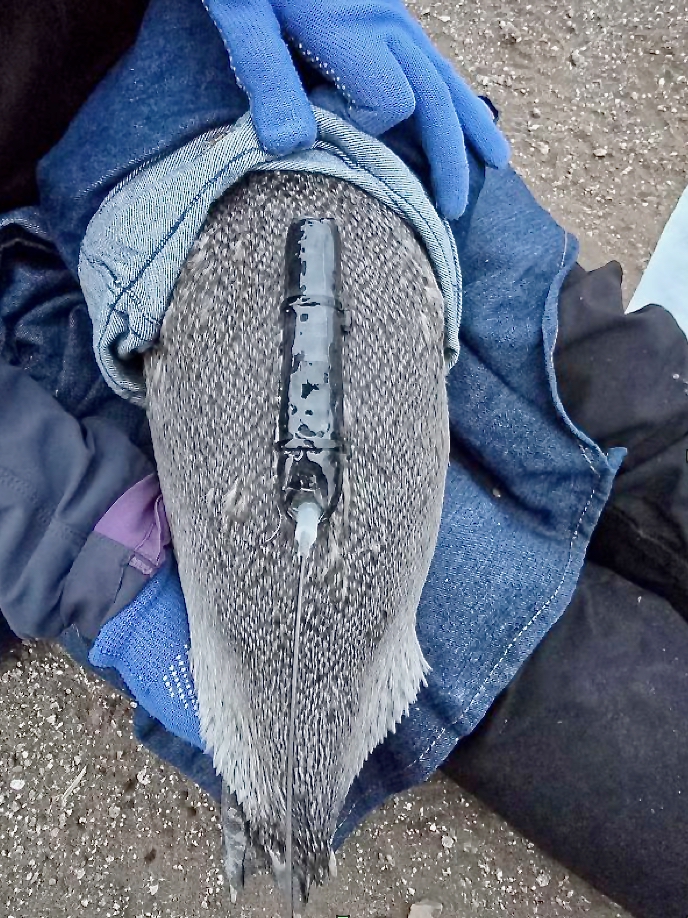
(…) On July 23 and 24, 2025, we fitted five Humboldt penguins—which are raising their chicks on Cachagua Island in Central Chile—with satellite transmitters. The birds were captured by hand at their nests while they were caring for their chicks, which were about six weeks old. All birds were in the (southern) fall breeding season. The satellite transmitters were secured to the midline of the back with waterproof adhesive tape (Tesa, Beiersdorf AG, Hamburg, Germany) and coated with a layer of fast-curing epoxy resin to prevent the birds from removing the tape with their beaks. The attachment process took about 15–25 minutes per bird (Figure 1).
The birds were weighed using a digital scale accurate to 0.1 kg. A digital caliper was used to measure the beak length (BL) from the junction between the feathered and unfeathered sections on the back of the beak to the tip, as well as the beak width (BD) at the level of the nostrils (all measurements were taken to an accuracy of 0.1 mm). In addition, all birds were fitted with a subcutaneous transponder (Trovan 11 mm) on the crown of the head to provide a unique identification code. Details on the tracked birds are listed in Table 1.
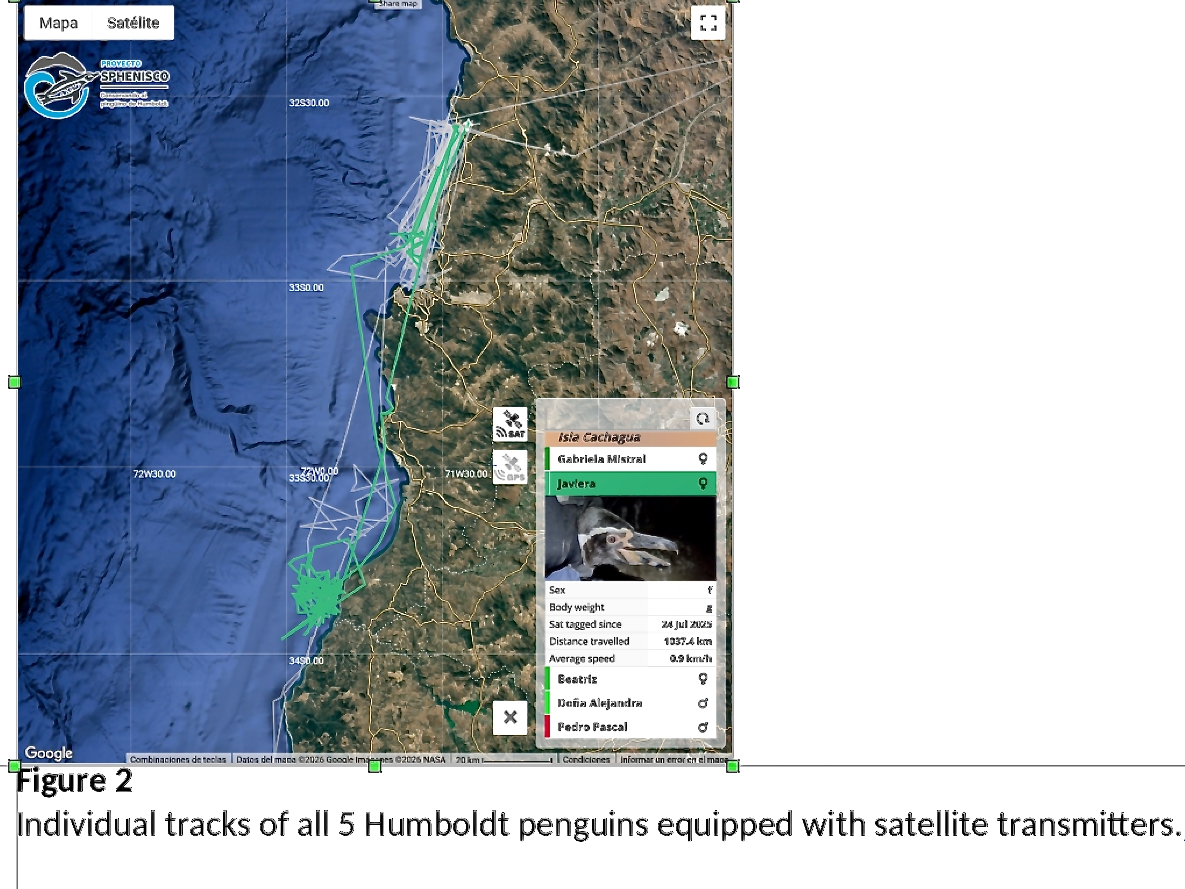
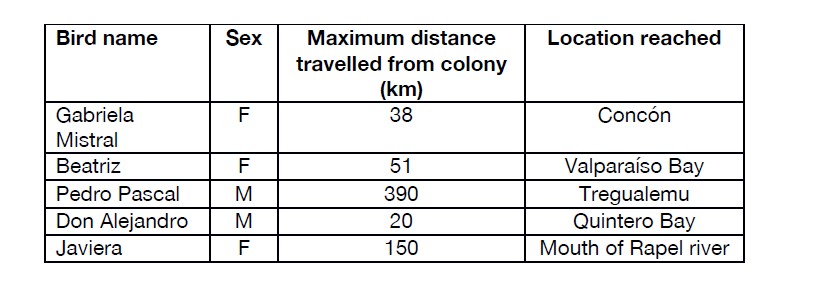
Table 1 - Morphometric data for the five adult Humboldt penguins that were fitted with satellite transmitters. BL = bill length, BD = bill depth, ID = transponder code.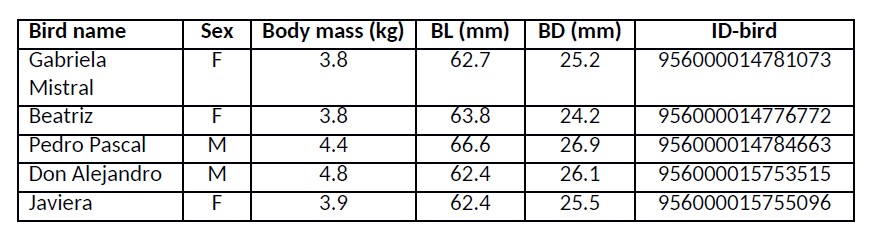 All the birds flew south, covering varying maximum distances ranging from 20 to 390 km (Table 2). The individual flight paths are shown in Figures 2–4 (see below).
Table 2 - Maximum distances traveled by the five adult Humboldt penguins equipped with satellite transmitters.
 On August 3 (11 days after the transmitters were deactivated), we visited Cachagua again. All five nests were still active. Four birds equipped with transmitters were at sea, with the exception of Beatriz, who was spotted in the colony along with other penguins (Figure 5, see below). All nests contained adult birds (pairs) with chicks, with the exception of Javiera’s nest, which contained two chicks approximately 8 weeks old without any adults watching over them.
Another visit took place on September 25 (64 days after the transmitters were attached), coinciding with the start of the (southern) spring breeding season. Although one transmitter was still sending a signal from the colony, no birds with transmitters were sighted. We assume that this device was possibly located in a cave and was transmitting a signal from there. Of the five monitored birds, we were able to confirm that three of them had begun nesting again. No activity was observed at Gabriela Mistral’s nest; the nests of Beatriz, Pedro Pascal, and Don Alejandro contained adult birds (presumably their mates) incubating their eggs. Javiera’s nest had collapsed due to the winter rains.” (4)
Conclusion
The Antarctic Research Trust summarizes the findings as follows: “A key finding from the analysis of the initial data is that all five penguins consistently remained near the coast; none swam out into the open ocean. Somewhat surprisingly, only two of the birds ventured more than 100 kilometers from their breeding colony on Cachagua Island. One bird traveled nearly 400 kilometers south, while the other covered about 140 kilometers. The remaining three penguins stayed within their usual foraging grounds—the same areas they use during the breeding season—but spent several days at a time at sea in some cases. It is also noteworthy that the penguins particularly frequently sought out regions with intensive human activity: for example, the waters around the port cities of Valparaíso and Viña del Mar, as well as the estuary of the heavily polluted Maipo River. At first glance, this seems paradoxical. However, these areas may be attractive to the animals because they are less heavily fished due to shipping traffic or pollution and thus may offer a more reliable food source.” (5)
W.K.
Notes
For the sake of readability, the generic masculine form is used in this article. Unless otherwise indicated, references to people in this article apply to all genders.
(1) Humboldt Penguin Research Group, Santiago, Chile.
(2) One Health Institute, Andrés Bello University, Santiago, Chile.
(3) The Antarctic Research Trust (ART) is a nonprofit foundation registered in the Falkland Islands, Switzerland, and the United States. The foundation’s goal is to conduct or support scientific research projects on Antarctic and sub-Antarctic animals in order to better protect these animals and their habitats. ART is a member of Sphenisco.
(4) Maximiliano Daigre (1), Paulina Arce (1), and Alejandro Simeone (1) (2). Satellite tracking of chick-rearing Humboldt penguins from Cachagua Island, central Chile. 2025.
(5) On the Trail of the Humboldt Penguins, Zurich, October 3, 2025. https://www.zoo.ch/de/zoonews/auf-den-spuren-der-humboldtpinguine
translated by Angelika Veelken using/reviewing deepl.com